
















Knowledge Center: Your Go-To Resource for ADUs and Tiny Living
Knowledge Center: Your Go-To Resource for ADUs and Tiny Living
Email [email protected]
Phone 860-TINY-HOM (es)
How Long Does It Take to Build an ADU in Connecticut? Real Timeline for Homeowners
If you are planning a backyard living space in Connecticut, an in-law suite, or a full Accessory Dwelling Unit (ADU), one of the first questions you will ask is simple:
How long does it actually take?
The honest answer is this:
Most homeowners should plan on 6 to 10 months from the first property conversation to move-in.
The construction phase itself is usually around 6 months, but that is only part of the timeline. What catches many homeowners off guard is everything that needs to happen before construction begins. That early work, including feasibility, design direction, and permitting, usually takes 4 to 10 weeks total, depending on the property and the town.
That matters whether you are building an ADU in Connecticut for a parent, creating a family ADU in Connecticut, planning for rental income, or trying to coordinate timing with the sale of another home.
Want to know whether your property is a fit for an ADU? Schedule a consultation to review feasibility, layout options, and next steps for your Connecticut home.
Quick Answer: ADU Timeline in Connecticut
For most homeowners, the full timeline to build an ADU in Connecticut looks like this:
Feasibility and property review: 1 to 2 weeks
Design and planning: 1 to 3 weeks
Permits and approvals: 2 to 6 weeks
Construction: around 6 months
Final walkthrough and closeout: 1 to 2 weeks
Some of these early steps can overlap, which is why the full project timeline usually stays within the 6 to 10 month range.
Why the Timeline Feels Shorter Than It Really Is
A lot of homeowners hear that an ADU takes about six months and assume that means the whole project.
Usually, that number refers to the construction phase, not the full project timeline.
What often gets missed is the preconstruction work that happens before the build starts, including:
property feasibility
layout decisions
survey and utility review
permit preparation
town approvals
site-specific planning
Those steps usually do not take as long as construction, but they still matter. They are also one reason the full process is better described as a 6 to 10 month project, not just a 6 month build.
The 4 Phases That Determine Your ADU Timeline
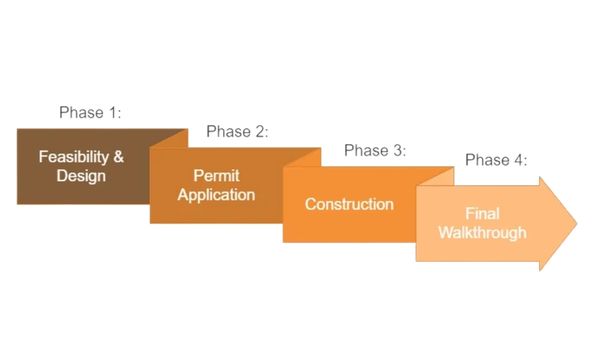
To make the timeline easier to understand, it helps to think about the project in four phases: Feasibility & Planning, Permitting, Construction, and Final Walkthrough.
1. Feasibility & Planning
Typical range: 2 to 4 weeks
This early phase is where you confirm whether the property can support the ADU and what type of layout makes sense.
This phase often includes:
reviewing zoning and town rules
checking setbacks and placement options
comparing attached and detached ADU options
reviewing septic, sewer, utility, and access conditions
identifying site constraints like wetlands, slope, trees, or driveway limitations
narrowing down the layout, size, and use case
This stage is important because it removes uncertainty early and helps prevent delays later.
2. Permitting
Typical range: 2 to 6 weeks
Once the direction is clear, the next step is permit preparation and town review.
This phase can vary based on:
how quickly the town reviews submissions
whether the documents are complete
whether the property has septic, survey, or access issues
whether revisions are requested
This is usually the least predictable part of the early timeline, but it should still be understood as part of a total project window that stays within the broader 6 to 10 month range.
3. Construction
Typical range: around 6 months
Once permits are approved, the project moves into active construction.
This phase usually includes:
site preparation and foundation work
framing and structural work
roofing, siding, windows, and exterior enclosure
plumbing, electrical, and HVAC installation
insulation and finish work
inspections during the build
This is the longest phase and the one most homeowners picture first.
Construction can still take longer if the site presents surprises such as rock, drainage issues, weather delays, or more complex utility trenching than expected.
4. Final Walkthrough
Typical range: 1 to 2 weeks
The last phase is where the project gets reviewed, finished, and prepared for use.
This phase may include:
final walkthrough items
touch-ups or punch-list corrections
inspection closeout items
final confirmation that the space is ready for move-in or occupancy
This is a shorter phase, but it still matters. If you are planning around a move-in date for a parent, a rental start date, or a future downsizing plan, this last step should still be built into your timing.
Realistic ADU Timeline Scenarios for Connecticut Homeowners
Scenario 1: Ready property, straightforward approvals
Feasibility and planning: 2 to 3 weeks
Permitting: 2 to 4 weeks
Construction: 6 months
Final walkthrough: 1 week
Total: about 6 to 7 months
This is the kind of timeline homeowners hope for when the property is relatively simple, the survey is available, utilities are straightforward, and the town process moves smoothly.
Scenario 2: Typical Connecticut ADU project
Feasibility and planning: 3 to 4 weeks
Permitting: 4 to 6 weeks
Construction: 6 months
Final walkthrough: 1 to 2 weeks
Total: about 7 to 9 months
This is a realistic planning range for many families building a family ADU in Connecticut or a backyard living space in Connecticut.
Scenario 3: More complex property or approval path
Missing or outdated survey
Septic review or upgrade needed
Challenging placement conditions
Extra site work, utility trenching, or driveway planning
Total: up to 10 months
This does not mean the project is a bad fit. It usually means the property needs more upfront coordination before the build can move efficiently.

What Actually Delays ADU Projects the Most
Based on repeated buyer questions and objections, these are some of the biggest timeline slowdowns:
1. Waiting too long to check feasibility
Many homeowners spend months researching general ADU information before confirming whether their own property can support the project.
2. Missing documents
The most common examples are:
no survey
an outdated survey
missing septic records
unclear utility information
3. Site constraints that show up late
Common site issues include:
wetlands
sloped land
leach field restrictions
tree clearing needs
limited driveway access
longer utility trenching than expected
4. Financing timing
Some households are ready in principle but still need to coordinate the sale of another home, home equity access, or cash timing.
5. Town-specific review pace
Every Connecticut town handles review a little differently. Some move fast. Others take longer, especially when the site or submission is more complicated.
How to Move Faster Without Cutting Corners
If timeline matters, these steps usually create the biggest advantage:
1. Start with a real property review
Do not rely on generic advice alone. A site-specific review is what tells you whether the property, layout, and town rules are pointing toward a fast path or a slower one.
2. Gather documents early
Try to collect these as early as possible:
property survey
septic records if applicable
well information if applicable
utility details
any past town guidance related to your lot
3. Decide on layout sooner than later
The faster you narrow your use case, the easier it is to move forward.
Examples:
one bedroom for a parent
two bedrooms for rental flexibility
one bedroom plus office for long-term downsizing
4. Use plain language when planning the project
A lot of homeowners start by saying they want a backyard living space, in-law suite, or second small home on their property. That is helpful. Start there, then translate that into ADU requirements, design, and permitting needs.
5. Work with a Connecticut-focused team
A Connecticut ADU builder who understands local permitting, siting, and site-work realities can help reduce unnecessary back-and-forth and surface risks earlier.
Want clarity on your likely timeline, placement options, and next steps? Book a consultation to review your property and talk through a realistic ADU path for your Connecticut home.
How to Plan Backward From Your Target Move-In Date
One of the best ways to reduce stress during an ADU project is to work backward from the date you actually want the space ready.
For example:
If you want a parent to move in by fall, start feasibility and planning well before summer.
If you want rental income next year, begin early enough to account for permits, site work, and town review.
If the project depends on selling another home, line up feasibility early so you understand timing before you make other financial decisions.
If your property has septic, wetlands, slope, or access constraints, build extra time into the schedule from the beginning.
This is where many homeowners get tripped up. They plan around the ideal construction window, but the real timeline is shaped by everything that happens before the first day of building.
A better approach is to treat the ADU timeline like a sequence of decisions, not just a construction countdown. When you know your property constraints, documents, layout priorities, and town process early, it becomes much easier to plan with confidence.
Final Thought
When homeowners ask how long it takes to build an ADU in Connecticut, they are usually asking a bigger question:
How long until this feels real and move-in ready for my family?
That answer depends on three things more than anything else:
your property
your town
your readiness to move from idea to plan
The fastest ADU projects are not the ones that rush.
They are the ones that get clarity early, make smart decisions upfront, and move through each stage with fewer surprises.
If you are thinking about an ADU in Connecticut for family, rental income, future downsizing, or a private backyard living space, the best first step is not guessing the timeline. It is finding out what your property can support.
Ready to talk through feasibility, layout options, and timing? Schedule a consultation and get a clearer next step for your Connecticut property.
FAQs
How long does it take to build an ADU in Connecticut?
Most homeowners should plan on 6 to 10 months total, including feasibility, planning, permitting, construction, and final walkthrough. The construction phase itself is usually around 6 months.
Why does the full timeline take longer than construction?
Because the full project includes preconstruction work such as feasibility, layout decisions, permit preparation, town approvals, and site-specific planning before the build begins.
How long does preconstruction usually take for an ADU?
For many Connecticut homeowners, preconstruction usually takes about 4 to 10 weeks total, depending on the property, the documents available, and how quickly the town reviews the submission.
What usually delays an ADU project?
The most common delays are missing surveys, septic questions, site constraints, long utility runs, design indecision, and slower town review.
Can an ADU project finish in about 6 months?
Yes, in some straightforward cases the full process can land close to 6 months, but many projects take longer depending on permitting, site conditions, and property complexity.
Does every Connecticut town take the same amount of time for permits?
No. Town timelines vary. Some are faster and more straightforward, while others take longer based on review volume, local rules, and project complexity.
When should I start if I want to move in next year?
If you have a target move-in date next year, it is smart to begin the feasibility and planning process 6 to 10 months in advance, and earlier if the property may need extra site work, septic review, or added approvals.


Copyright 2026. All rights reserved. Norwalk, CT
Connecticut's New Home Construction Contractor License: #NHC.0017654
EPA Lead-Safe Certified NAT-F269966-1