






















Knowledge Center: Your Go-To Resource for ADUs and Tiny Living
Knowledge Center: Your Go-To Resource for ADUs and Tiny Living
Email [email protected]
Phone 860-TINY-HOM (es)

What Is an ADU in Real Estate, and How Can It Affect Your Property?
You may be considering a home with a guest cottage in the backyard. You may already own a property and wonder whether a second living space could increase its value. Or you may be an investor asking whether one lot can support two useful income streams.
That leads to an important question: what is an ADU in real estate?
An ADU, or Accessory Dwelling Unit, is a secondary residential unit on the same lot as a primary home. It can be occupied by family, rented to a tenant, used for guests, or planned as a future downsizing option.
In ADU real estate, the unit can affect property value, rental income, financing, appraisal, resale, taxes, insurance, and how buyers compare one property with another.
The real opportunity depends on more than adding square footage. The ADU must be legal, well designed, useful to the market, and appropriate for the property.
Talk To An ADU Expert
What Qualifies as an ADU in Real Estate?
An ADU must function as an independent living space.
Fannie Mae describes an ADU as a smaller additional living space on the same lot as a single-family home. It must include independent areas for living, sleeping, cooking, and bathing. It must also be accessible without requiring the occupant to pass through the primary residence and should provide reasonable privacy.
This helps answer the question, “What is ADU in real estate?”
An ADU is not simply a finished shed, guest bedroom, pool house, or home office. It is a residential unit that supports daily living.
Six common ADU types appear in real estate listings and construction plans.
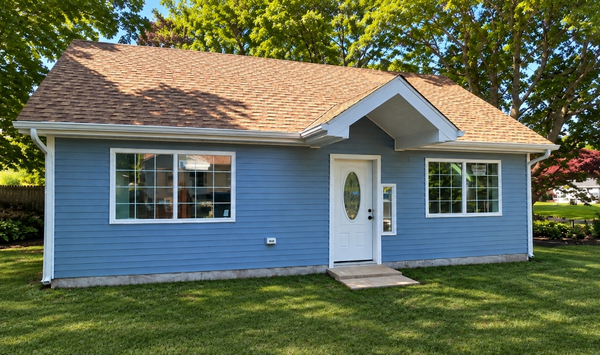
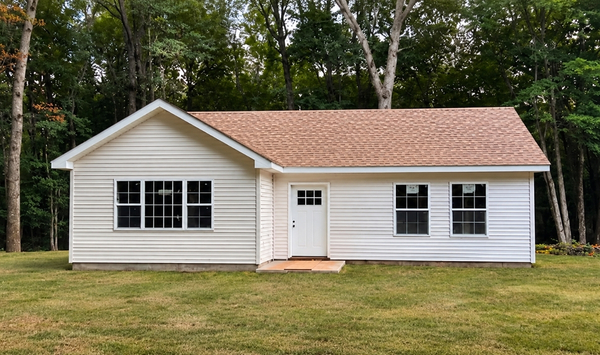
Detached New-Construction ADU
A detached ADU is a separate residential structure on the same lot as the main home.
It is often placed in the backyard. This option can provide strong privacy for the homeowner and the ADU occupant.
It may work well for aging parents, adult children, tenants, caregivers, or owners who plan to downsize later.
A detached ADU usually requires a new foundation, site work, utility connections, and construction access. Its location may be affected by setbacks, lot coverage, drainage, septic areas, wetlands, parking, and the usable part of the lot.
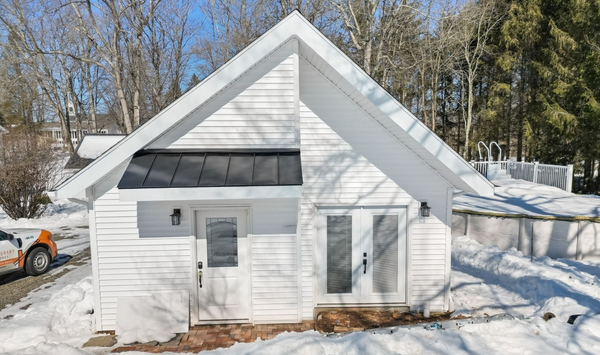
Garage Conversion ADU
A garage conversion turns an attached or detached garage into a legal living unit.
The project may use the existing foundation and structure. However, the garage may still need insulation, plumbing, electrical work, heating and cooling, windows, fire separation, moisture protection, and structural improvements.
The loss of parking or storage may also affect the property’s usefulness and resale appeal.
Above-Garage ADU
An above-garage ADU adds living space over an attached or detached garage.
This approach may preserve parking while creating a separate residence. It can require structural reinforcement, stairs, fire separation, utility extensions, and careful planning for sound and privacy.
Accessibility may be a concern because the home is usually reached by stairs.
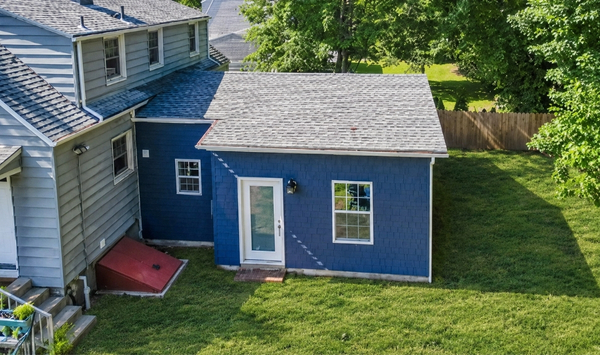
Attached ADU Addition
An attached ADU shares at least one wall with the primary residence.
It may be built as a side or rear addition. It can work well when the property lacks enough open space for a detached structure.
An attached layout may allow shorter utility extensions, but it still needs clear separation between households. Entrances, sound control, windows, parking, and private outdoor areas should be considered during design.
Basement Conversion ADU
A basement conversion turns an existing lower level into a self-contained residence.
The space must support safe residential use. Ceiling height, emergency egress, waterproofing, drainage, plumbing, ventilation, natural light, and fire separation can affect feasibility.
A finished-looking basement is not automatically a legal ADU.
Interior Junior ADU
A Junior ADU, often called a JADU, is a smaller unit created within the existing footprint of the main home.
Some jurisdictions recognize JADUs as a separate category with different size, kitchen, bathroom, or occupancy rules.
Connecticut homeowners should verify whether their municipality uses this classification before assuming a smaller interior unit qualifies.
All six types can affect value differently. Their cost, privacy, legal status, layout, and market appeal vary.
Connecticut law currently uses the term “accessory apartment.” It defines one as a separate dwelling unit on the same lot as a larger principal dwelling, with cooking facilities and compliance with applicable building, fire, health, and safety requirements.
How Does an ADU Affect Property Value?
An ADU can increase property value, but there is no universal percentage that applies to every home.
A peer-reviewed Los Angeles study found that ADU presence was associated with a 7% to 9% increase in assessed value and selling price. The result is useful evidence, but it should not be treated as a guaranteed return for a Connecticut property. Local demand, construction quality, zoning, legal status, size, privacy, and comparable sales all matter.
Federal Housing Finance Agency data also found that California properties with ADUs experienced higher annualized growth in median appraised value than properties without ADUs between 2013 and 2023.
FHFA noted that more analysis is needed, so the difference does not prove that the ADU caused the full increase.
An ADU can affect property value in two main ways.
Additional Living Space
A legal ADU adds usable residential space.
Buyers may value that space for family, guests, caregiving, rental use, a home office, or future downsizing.
An appraiser may consider:
ADU size
Bedroom and bathroom count
Condition
Construction quality
Privacy
Legal status
Utility
Local comparable properties
The added square footage does not always receive the same value per square foot as the primary home. The market response depends on how functional and desirable the unit is.
Income-Producing Potential
An ADU may create another income stream on the same property.
That can make the home more attractive to buyers who want help offsetting housing expenses. It may also improve the property’s income profile for an investor.
Projected rent should remain conservative.
Vacancy, repairs, maintenance, insurance, utilities, property management, taxes, and financing costs reduce the amount the owner actually keeps.
People sometimes search “what is a ADU in real estate” because they want a simple promise about value.
The better question is whether the specific unit is permitted, useful, marketable, and supported by local demand.

ADU Rental Income: What Real Estate Investors Need to Know
What does ADU mean in real estate for an investor?
It can mean two potential income streams on one lot.
An owner may live in the main home and rent the ADU. A qualifying investor may rent both spaces, depending on financing and local rules. A family may also use the ADU for relatives now and rent it later.
Before estimating return, calculate the complete rental model.
Consider:
Expected monthly rent
Vacancy
Routine maintenance
Repairs
Utilities paid by the owner
Insurance
Property taxes
Property management
Replacement reserves
Financing costs
Gross rent is not the same as profit.
Short-Term Rental Rules
Short-term rental use should never be assumed.
Connecticut’s accessory-apartment framework allows municipalities to prohibit or limit short-term rentals and vacation stays. A buyer should verify the rule before purchasing a property based on projected Airbnb-style income.
Owner-Occupancy Requirements
Owner-occupancy rules vary by state and municipality.
The American Planning Association identifies owner occupancy, parking, lot size, design, bedrooms, and other conditions as common parts of local ADU regulations.
A buyer should confirm whether the owner must live in the primary home or ADU before relying on a rental strategy.
ADU Income and Mortgage Qualification
Fannie Mae and Freddie Mac both provide mortgage options for qualifying properties with ADUs.
Fannie Mae states that Selling Guide loan products can be used to purchase a home with an ADU, renovate an existing unit, or add a new ADU.
HomeReady borrowers purchasing or refinancing a home with an existing ADU may be able to use rental income to help qualify.
Fannie Mae updated its policy in 2025 to allow qualifying income from one ADU in certain transactions. Its March 2026 appraiser guidance states that the income used may not exceed 30% of the borrower’s total qualifying income. Other documentation requirements apply.
Freddie Mac also allows financing for properties with ADUs. ADU rental income may be considered as qualifying income when its requirements are met.
These policies do not guarantee approval. Borrowers should speak ADU financing options with a qualified lender before relying on projected ADU income.
ADU Real Estate Rules: What Varies by State and City?
There is no single national ADU rulebook.
What is legal in one state or city may be limited in another.
Common variables include:
Setbacks
Lot coverage
Maximum square footage
Building height
Parking
Owner occupancy
Short-term rentals
Utility requirements
Wells and septic systems
Permit timing
Connection or impact fees
This is why buyers should verify local zoning before purchasing a property with the assumption that an ADU can be added.
Connecticut ADU Rules
Connecticut has a statewide framework for accessory apartments.
Current law generally calls for at least one accessory apartment to be allowed as of right on a lot containing a single-family dwelling. It allows the unit to be attached, internal, or detached.
The framework sets a maximum size that must be no less than 30% of the primary home’s net floor area or 1,000 square feet, whichever is less. A town may allow a larger unit.
The law also addresses:
Setbacks
Lot coverage
Building height
Parking
Utility connections
Permit review
Short-term rentals
Wells
Private sewerage systems
Municipalities may opt out through the statutory process, so town-level confirmation is still necessary.
A large yard does not automatically mean the property can support an ADU.
The lot may have septic limits, wetlands, drainage problems, utility conflicts, difficult construction access, existing nonconforming structures, or limited usable building area.
A garage may also look suitable for conversion but fail to meet structural, ceiling-height, fire-separation, or egress requirements.
Before buying a home because you plan to add an ADU, review zoning and property feasibility first.
Request a Feasibility Analysis
Is Building an ADU Worth It? A Framework for the Decision
An ADU can be a strong real estate decision when the property supports it and the use case is clear.
It can be a poor investment when costs are underestimated, rent assumptions are aggressive, or the unit is not legally permitted.

The next step is not choosing finishes or estimating rent.
It is determining what is actually buildable on the lot, what the complete project may cost, and whether the ADU solves the owner’s real housing or income goal.
Get a Free ADU Feasibility Consultation
Frequently Asked Questions
What Does ADU Mean in Real Estate?
ADU means Accessory Dwelling Unit.
In real estate, it refers to a secondary residential unit on the same lot as a primary home. It can provide independent space for relatives, tenants, caregivers, guests, or owners planning for future downsizing.
What Does ADU Stand for in Real Estate?
ADU stands for Accessory Dwelling Unit.
“Accessory” means the unit is secondary to the primary home. “Dwelling unit” means it includes the core facilities needed for residential living, including areas for sleeping, cooking, bathing, and daily use.
Does an ADU Increase Home Value?
It can, but the result varies.
A Los Angeles study found an association between ADUs and a 7% to 9% increase in assessed value and selling price. That result is market-specific and does not predict the exact outcome for a Connecticut home.
Permits, condition, size, privacy, rental demand, layout, and local comparable sales all affect value.
Can You Get a Mortgage on a Home With an ADU?
Yes.
Fannie Mae and Freddie Mac both support financing for qualifying properties with ADUs. Rental income may be considered in certain transactions when program, appraisal, documentation, and borrower requirements are met.
What Is the Difference Between an ADU and a DADU?
ADU is the broader category. It includes internal, attached, and detached units.
DADU means Detached Accessory Dwelling Unit. It is a stand-alone residential structure on the same lot as the primary home.
Every DADU is an ADU. Not every ADU is detached.
Ready to Explore What an ADU Can Do for Your Property?
An ADU can create rental income, flexible family housing, added living space, and potential resale value.
The outcome depends on the property, local rules, complete project cost, construction quality, financing, legal status, and intended use.
For Connecticut homeowners and investors, the next step is finding out what is actually possible on the lot.
Contemporary Tiny Homes helps homeowners review property feasibility, compare suitable ADU models, and move through design, permitting, site work, utilities, and construction with a guided process.
Ready to understand what an ADU could do for your property? Schedule a free consultation with Contemporary Tiny Homes to review feasibility, likely cost factors, available options, and the next steps for your Connecticut project.
See Our ADU Models


Copyright 2026. All rights reserved. Norwalk, CT
Connecticut's New Home Construction Contractor License: #NHC.0017654
EPA Lead-Safe Certified NAT-F269966-1